Water Extraction and Removal in Anoka, MN
Standing water in an Anoka basement, entry or finished room is pumped and extracted first, then crews map what stayed wet and dry it to readings.
(888) 432-4933Get water pulled out now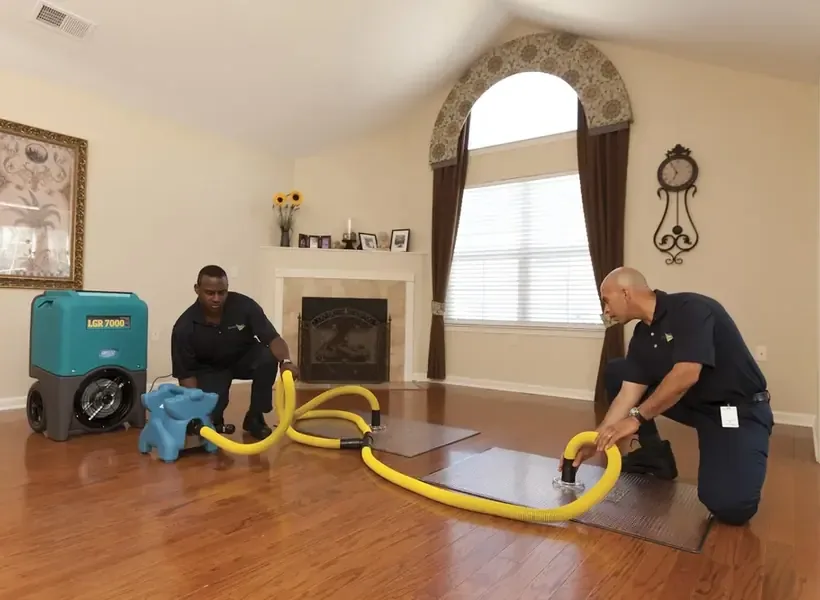
First steps for water extraction and removal
- 01Stop the source Close the supply valve if a pipe or tank is leaking.
- 02Check the breaker Stay out of wet rooms with live outlets until that breaker is off.
- 03Move what you can Lift rugs, shoes and small furniture onto dry ground.
- 04Photograph first Take wide and close photos of the depth and every wet surface.
In a river city with the Rum River and the Mississippi River both carrying flood risk, standing water is the problem to solve first. Every inch left on a floor soaks further into pad, baseboards and subfloor, so extraction comes before any drying equipment.
Submersible pumps take down depth, and truck-mounted extractors then pull the thin film that remains in carpet and pad.
What does water extraction and removal cost in Anoka, MN?
Cost follows depth, floor area and how much carpet and pad must be lifted. A single wet room sits at the low end, while deep water or two flooded levels requires heavier pumps and more hauling.
One wet room or basement corner
- Standing water pumped out
- Carpet extracted
- Readings recorded
Finished basement, most of it
- Pad extracted under weight
- Baseboards checked
- Wet pad hauled away
Deep water, two levels
- Submersible pumps and trucks
- Debris and silt removed
- Moisture map after pumping
Ranges are typical, not a quote: the water category, square footage, material class and how fast drying started move the number most. The water damage cost calculator gives a closer range.
How water extraction and removal is handled, step by step
The tech who does the walkthrough maps moisture before any equipment goes down, and the equipment stays until the readings say dry.
Pump
Submersible pumps take down standing depth.
Extract
Truck-mounted wands pull water from carpet, pad and hard floors.
Check
Meters trace moisture into baseboards, wall bottoms and the subfloor.
Hand off to drying
Equipment is set and readings are logged daily until dry.
What gets pumped and lifted
- Standing water in basements, entries and window wells
- Soaked carpet and pad that cannot be saved
- Water trapped under vinyl, laminate or tile
- Slurry and silt left behind by river or storm water
Salvageable flooring is lifted and set aside so the subfloor can breathe, while pad and loose debris are hauled out.
Why the floodplain matters
The county hazard plan counts 110 potential buildings damaged in the city's floodplain, where city sewer infrastructure also sits. Water that reaches a lower level may be river water, storm water or sewage, and its category decides how the crew handles it.
After the water is gone
Once the pumping stops, the extraction crew checks baseboards, wall bottoms and the subfloor with a meter. Wet areas that extraction cannot reach are opened, and structural drying equipment finishes what pumps cannot.
Everything is photographed and logged along the way so the claim file shows how much was wet and how it was handled.
Water extraction and removal across Anoka and nearby communities
Extraction work reaches homes and buildings across the city, from older streets around Christian Hill and downtown to RiversPointe townhomes and the Goodrich Field area, and the whole service area along Highway 10 and Highway 169 in ZIP 55303.
The same service nearby: water extraction and removal in Andover, Blaine, Oak Grove.
Every town coveredRelated water damage services in Anoka
Water Extraction and Removal questions in Anoka, MN
Water still coming in?
Water still standing on the floor? Pumping can begin while the details are sorted out.
(888) 432-4933 (888) 432-4933Get pumps startedHow is extraction different from drying?
Extraction removes liquid water with pumps and wands. Drying pulls the moisture that remains in materials into the air with dehumidifiers and air movers, and it takes days.
Can wet carpet be saved after extraction?
Clean water on carpet that is extracted promptly can often stay, but pad usually comes out. Gray or black water means the carpet and pad are removed.
What if the water came from the river or a storm?
River and storm water carry silt and bacteria, so it is treated as category 3. Porous materials come out, and surfaces are cleaned before drying starts.
Do pumps run when the power is out?
Gas or generator powered equipment can pump a flooded basement during an outage, but the electrical panel must be safe before anyone steps into the water.
How deep can extraction work go?
Submersible pumps handle water several feet deep, and truck-mounted units clear what remains. Saturated pad, drywall and insulation are removed afterward.
Does insurance pay for extraction?
Sudden leaks and burst pipes are commonly covered, while slow seepage and groundwater often are not. The claim file is easier with photos taken before the water is moved.
Get standing water out of the house
Extraction, moisture mapping and drying all start from one conversation, and photos and readings are kept together for the insurance claim.
(888) 432-4933Call for extraction