Structural Drying and Dehumidification in Andover, MN
Surfaces dry long before framing, subfloor and concrete do. The drying team sets air movers and dehumidifiers to the class of loss and logs readings until every material matches a dry reference.
(888) 432-4933Get the drying started today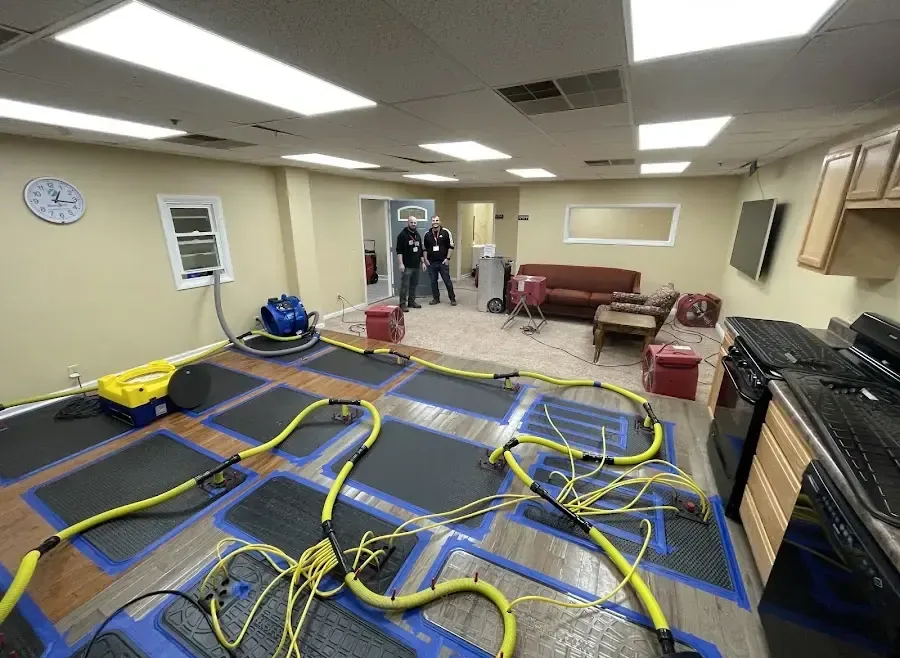
First steps for structural drying and dehumidification
- 01Leave the equipment on Do not turn off air movers or dehumidifiers; drying stalls.
- 02Keep doors closed Keep the drying area closed so the dehumidifiers work on that air.
- 03Keep the heat on Hold a normal indoor temperature; cold rooms dry slower.
- 04Leave hoses in place Most units pump out on their own; leave drain hoses where the crew set them.
Structural drying is the part of a water loss nobody sees: getting the water out of the framing, subfloor, drywall and concrete, not just off the surface. A wall can feel dry a day after a leak while the bottom plate behind it is still soaked. The drying team measures, sets equipment to the load, measures again every day, and stops only when the numbers say the material is dry.
What does structural drying and dehumidification cost in Andover, MN?
Structural drying in Andover, MN typically runs $1,000 to $8,000, depending on the class of loss, how many rooms are drying, how many days the equipment runs and whether desiccant drying is needed for dense materials.
One room, Class 1 to 2
- Moisture map
- Air movers and LGR
- Daily logs
Several rooms or a basement
- Containment
- Multiple dehumidifiers
- Wall cavity drying
Class 4, hardwood or concrete
- Desiccant drying
- Drying mats
- Extended monitoring
Ranges are typical, not a quote: the water category, square footage, material class and how fast drying started move the number most. The water damage cost calculator gives a closer range.
How structural drying and dehumidification is handled, step by step
The tech who does the walkthrough maps moisture before any equipment goes down, and the equipment stays until the readings say dry.
Map
Moisture mapping marks every wet material.
Set
Air movers and dehumidifiers are placed for the class of loss.
Monitor
Daily psychrometric and moisture readings.
Verify
Equipment leaves when readings match the dry reference.
How the drying plan is set
- The water category decides what gets removed and what gets dried
- Class 1 to 4 sets how much evaporation the room needs
- Air movers are placed by wall length and wet floor area
- Dehumidifiers are sized to the room volume and the class
LGR and desiccant dehumidifiers
Low-grain refrigerant (LGR) dehumidifiers pull more water out of cool air than household units, which matters in basements. For Class 4 materials, such as hardwood, plaster and concrete, desiccant dehumidifiers make very dry air that pulls bound water out of dense materials. Plastic containment keeps the drying air where it is needed.
Readings and the dry standard
Every day the tech records temperature, relative humidity and grains per pound inside and outside the drying area, plus moisture readings at marked spots. Drying ends when wet materials read within 2 to 4 points of a dry reference material of the same type in the home. The EPA indoor air quality pages explain why indoor moisture control matters, and the University of Minnesota Extension covers moisture problems in Minnesota homes. Drying starts after water extraction removes the standing water.
Structural drying and dehumidification across the city and Anoka County
Coverage runs across ZIP 55304, from the Bunker Lake Boulevard and Hanson Boulevard corridors to the homes around Crooked Lake and Round Lake, the Coon Creek corridor, the Rum River side and the larger rural lots in the north of the city.
Nearby coverage reaches Ham Lake, Anoka, Coon Rapids, Blaine, Ramsey, Oak Grove, Spring Lake Park, East Bethel.
See every neighborhood and nearby city coveredRelated water damage services
Structural Drying and Dehumidification questions in Andover, MN
Water still coming in?
Wet framing or concrete? The drying team dries it to readings 24/7.
(888) 432-4933 (888) 432-4933Get structural drying set upWhy does drying take several days?
Water moves out of framing, subfloor and concrete slowly. Air movers speed evaporation from surfaces and dehumidifiers pull that moisture out of the air, but dense materials still need time.
Can the fans be turned off at night?
It is better not to. Drying stalls when the equipment stops, and the job runs longer.
What is a dry reference?
A material of the same type in an unaffected part of the home. Wet materials are dried until they read within 2 to 4 points of it.
Is the noise and heat normal?
Yes. Air movers are loud and dehumidifiers give off warm air, which actually helps drying.
What is the difference between LGR and desiccant dehumidifiers?
LGR units cool the air to condense water and work well in most rooms. Desiccant units use an absorbent wheel to make very dry air for dense materials and cold spaces.
How do I know the house is really dry?
The daily log shows the readings. When every marked spot matches the dry reference, the drying is done and documented.
Still damp after a leak? Get the structure dried right.
Surfaces dry first and hide water in framing and concrete. The drying team measures daily until it is truly dry.
(888) 432-4933Structural drying help, 24/7