Ham Lake has no municipal sewer system. Homes and businesses use individual or community septic systems, so when sewage rises in a floor drain, tub or toilet, the first question is about the tank on the property.
Key takeaways
- Homes and businesses here rely on individual or community septic systems, so a backup usually starts on the property.
- City code requires every septic system to be inspected at least once every 3 years.
- Sewage is contaminated water. Porous materials it touches are removed, not just dried.
- A full or failing tank keeps pushing water back, so a cleanup without a septic check can repeat.
- Anoka County's Well Septic Loan Program is a loan repaid through property taxes, not a grant.
Why a Ham Lake backup points to the septic system
In a city with a public sewer, a backup can come from a shared pipe in the street. Here there is no such pipe, so the tank, the pipes to it and the drain field are the places to look.
No municipal sewer to check
The Ham Lake water damage restoration team and a septic service work on different halves of the same problem. That changes the first phone call.
A septic service can open the tank and see how full it is, and a water damage team can handle what is already on the floor.
Both jobs matter, and neither replaces the other.
A business owner on Highway 65 faces the same question, and some of those owners already pay for frequent pumping.
Low ground and a high water table
The city sits on the Anoka sand plain, where soil is mostly sand. Low areas and depressions have a naturally high water table at or near the surface.
A drain field sitting in saturated ground has less room to absorb water, which is one reason a system can back up after heavy rain or snowmelt.
Warning signs before sewage reaches the floor
Septic systems often hint at trouble before they fail. The lowest drain in the house usually shows it first.
Catching the early signs gives a homeowner time to call a septic service before sewage reaches finished flooring.
- Drains gurgle or run slowly throughout the house, not just in one sink.
- Toilets flush weakly or bubble after a shower or a load of laundry.
- A sewage smell hangs around the tank lid or the yard.
- Ground over the drain field stays soggy or unusually green.
- Water or sewage shows up first in a basement floor drain or shower.
What to do when sewage is coming up
Every gallon sent down a drain adds to the backup. Stopping water use is the single most useful thing a homeowner can do.
The steps below cover the first stretch, while the tank is checked and the cleanup is arranged.
- Stop using water: no showers, laundry or dishwasher.
- Keep children, pets and anyone with a weak immune system out of the area.
- Do not walk through the water or use a household wet vacuum on it.
- Stay clear of outlets and the panel if water has reached them.
- Call a septic service for the tank and a water damage team for the cleanup.
Why sewage water is handled differently
Sewage can carry bacteria, viruses and parasites. That is why it is never treated like water from a supply pipe, even when it looks fairly clear.
The danger is not only on the floor. Droplets and wet materials can spread contamination to rooms that never got wet.
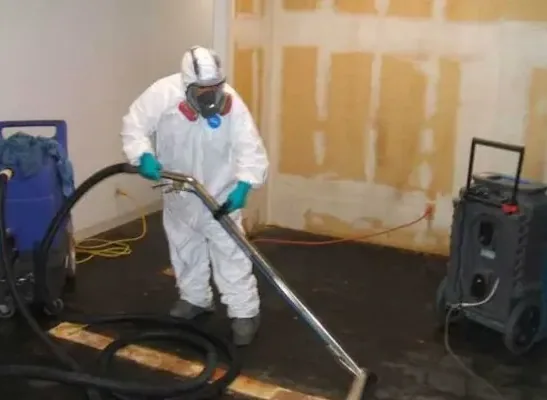
- Crews wear gloves, boots, eye protection and respirators.
- The heating and cooling system is shut off so air does not carry contaminants to other rooms.
- Wet items that cannot be cleaned are bagged and removed, not stored in the house.
- Children, pets and anyone with a weak immune system stay out until the cleanup is finished.
How sewage cleanup works
Sewage water is treated as contaminated from the moment it appears. The cleanup follows that rule at every step.
Removing the water and the porous materials
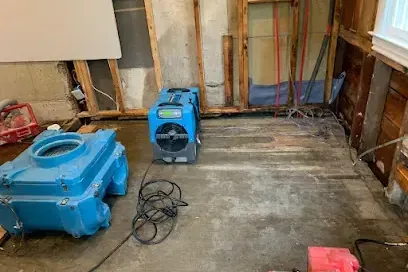
The crew extracts the water, then removes carpet, pad, low drywall, insulation and anything else that soaked it up. Porous materials cannot be made safe by drying alone.
Hard surfaces such as concrete are cleaned and treated, not thrown away.
Cleaning and drying
After removal, surfaces are cleaned and sanitized, and the space is dried with air movers and dehumidifiers. Moisture readings show when the framing and slab are back to normal.
Floor drains, baseboards and the bottom of walls get extra attention, because that is where sewage water sits longest.
The full job is covered by sewage backup cleanup and structural drying working together.
After the cleanup: the tank, the pipes and the drain field
A clean basement is only half the job. The reason sewage came up in the first place still has to be found.
A septic service can pump the tank, check the baffles and the outlet filter, and look at the drain field for signs of saturation. The broader sewage backup cleanup steps stay the same for any home.
- Ask what the tank looked like when it was opened: full, crusted or clear.
- Space out laundry loads so the system is not hit with a flood of water at once.
- Keep wipes, paper towels and grease out of the drains.
- Fix dripping fixtures and running toilets that add water all day.
- Make a note of the next inspection date so it does not slip past the 3 year rule.
Septic rules and records worth knowing
City code requires every septic system to be inspected at least once every 3 years. A tank must be pumped within 30 days when an inspection finds sludge or scum too close to the outlet baffle.
A compliance inspection is also required for a new or replacement system and when a bedroom is added to a home.
- Keep the pumping and inspection records in one folder; they help a septic service see what changed.
- Anoka County offers a Well Septic Loan Program. It is a loan repaid through property taxes, not a grant.
- Coon Creek was listed as impaired in 2006, and the watershed district names failing septic systems among the contributors.
Questions
Does Ham Lake have a municipal sewer?
No. The city has no municipal sewer system, and homes and businesses use individual or community septic systems.
Who should be called first after a septic backup?
Call a septic service to check the tank and a water damage team to clean up the floor. The two jobs happen in parallel.
Can carpet be saved after sewage touches it?
Usually not. Carpet and pad soak up contaminated water, so they are removed. Hard flooring and concrete can be cleaned and treated.
How often does a septic system have to be inspected?
City code requires an inspection at least once every 3 years, and pumping within 30 days if the inspection finds sludge or scum too close to the outlet baffle.
Is the county septic loan a grant?
No. The Anoka County Well Septic Loan Program is a loan repaid through property taxes.
What if only one toilet is overflowing?
A single toilet overflow can be a clog in that fixture. If other drains gurgle or the floor drain bubbles, the septic system is the likelier cause.