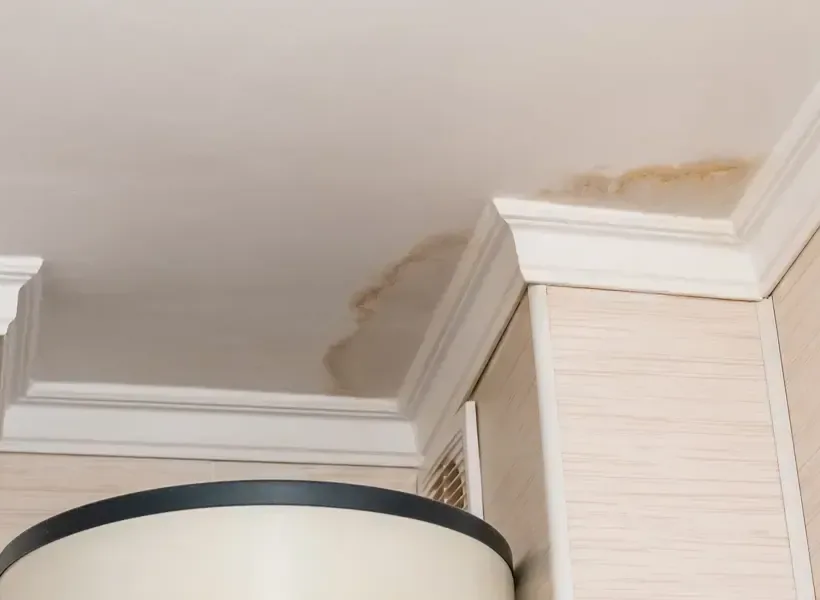
Thousands of homes in this city share a roof, a floor or a wall with a neighbor. In those buildings a leak rarely stays in one unit.
Key takeaways
- The 2024 Census estimate counts 5,465 attached homes and 2,109 units in buildings of 50 or more units.
- A ceiling stain usually traces to the roof, upstairs plumbing or an HVAC leak above it.
- Water travels through floor cavities and shared walls, so neighbors on several sides can be affected.
- Tell the association or building manager right away, and tell whoever lives above.
- Moisture mapping across every affected unit decides what is opened and dried.
Why attached homes make leaks spread
The 2024 estimate counts 19,986 detached single-family homes in the city, but also 5,465 attached homes and 2,109 units in buildings of 50 or more units. Those numbers describe a large group of residents who live close to a neighbor's plumbing.
Shared floors and walls
Water leaves a leaking unit by the easiest path. It follows pipes, floor joists and wall cavities and shows up one or two units away from the source.
Different owners and renters, one problem
The estimate also counts 4,478 renter-occupied households. A leak can involve an owner, a tenant, a landlord and a building manager at the same time.
Buildings with decades of appliances
The same estimate puts the median year Blaine homes were built at 1996, with 6,310 homes built from 2000 to 2009 and 4,796 from 1990 to 1999.
Buildings that age have been through many water heater swaps and appliance replacements, and every swap is a chance for a loose fitting.
Where the water usually comes from
A stain on a ceiling is the symptom. The source can be several floors up or only one.
Finding it quickly is the best way to limit what has to be opened and dried.
- Roof leaks reaching the top unit and dripping down walls and ceilings.
- Upstairs plumbing: a supply pipe, a drain, a tub or shower overflow.
- Appliances: a washer hose, a dishwasher connection, a refrigerator ice maker tube or a water heater.
- HVAC condensate that backs up and overflows a drain pan.
First steps in the unit that is getting wet
The first steps set the tone. A few simple actions limit the damage while the source is found.
Most of them take only a few seconds, and they matter more than any equipment brought in later.
- Catch drips with buckets and move electronics and bedding away from the water.
- Keep people out from under a ceiling that sags or bulges; it can hold a lot of water and fall.
- Photograph the stain, the dripping water and any wet belongings.
- Ask whoever lives above to shut off their water or the appliance involved.
- Call the building manager if nobody answers the door upstairs.
- Turn off lights and fixtures on a wet ceiling at the breaker, not at the switch.
Talking to neighbors, the association and management
A leak from another unit is stressful for everyone. Clear, written notes keep it from becoming a dispute.
Residents tend to feel blamed or ignored in these situations. Calm facts and photos usually move things along faster than arguments.
A short message to the association or manager should say where the water is, when it started and what has been done to stop it.
- Ask for the name of the person who will turn off the building's water if needed.
- Request written confirmation of when and where the source was stopped.
- Share photos and moisture readings with everyone who has a stake in the repairs.
How the drying team handles several units
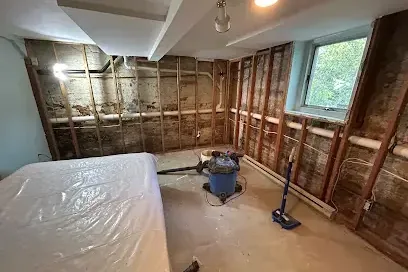
Water that crosses unit boundaries has to be tracked across all of them. One dry ceiling does not mean the neighbor's wall is dry.
The drying team starts with the unit where the damage is worst, then follows the moisture outward until readings come back to normal.
Ceilings, floor cavities and walls
The team uses moisture meters and thermal imaging to map where the water went. Wet drywall and insulation are cut out where readings call for it, as covered in ceiling leak water damage.
Equipment and readings
Air movers and dehumidifiers run in each affected unit, and readings are logged until every wall and floor is back to normal. Structural drying works the same way in a two-unit leak or a ten-unit one.
Roof leaks in a shared building
In a building with a shared roof, the top unit takes the first hit. Water then runs down walls and through ceilings below it.
Winter makes this worse, because snowmelt and refrozen edges push water under shingles slowly and quietly.
A roof repair is usually the association's job, but the water inside belongs to everyone below it.
- A stain that grows after rain or snowmelt points to the roof or a flashing detail.
- Wet attic or ceiling insulation can hold water for weeks and hide the real extent.
- Report the leak to management in writing so the roof inspection is on record.
- Read about ceiling leak water damage for how a stain is traced and dried.
Preventing the next leak from above
Most upstairs leaks come from parts that wear out quietly. A few habits catch them early.
Appliance leak water damage is one of the easiest kinds to prevent, and the Blaine water damage restoration team can explain what a check involves.
- Replace old washer hoses with braided ones and check them each year.
- Put a shutoff or a leak alarm on the water heater and washer.
- Watch for stains on ceilings after heavy rain; they point to the roof.
- Look under sinks and behind the washer twice a year for drips, rust or swollen cabinet bases.
- Know where your unit's main shutoff is, and tell everyone in the household.
Questions
How can I tell if a ceiling stain is a roof leak or a plumbing leak?
A stain that grows only after rain points to the roof. A stain that appears or grows on a dry day points to plumbing or an appliance above.
Should I open a bulging ceiling myself?
No. A sagging ceiling holds water and can fall. Keep people out and let a trained team release it safely.
How far can water travel from the source?
Through floor cavities and wall cavities, water can reach units on several sides and the floors below the source.
What if nobody answers the door upstairs?
Call the building manager or association, who can shut off water to the unit or the building.
How long does drying usually take?
Most units dry in a matter of days. Thick walls and subfloors take longer, and readings decide when the work is done.
Does a leak from above always reach the unit below?
Not always, but it often does. Water follows pipes and joists, so the unit below and the units beside the source are checked as a rule.